
Explore the complete employer-sponsored route for Indian professionals in South Korea, from securing a job offer and visa approval to understanding sector rules, compliance obligations, and the path to permanent residency.
2026 minimum salary floor for many E-7-1 professional roles
Standard residence period before permanent residence application
Your employer leads the CCVI pre-approval in Korea and submits your file to immigration before you visit the visa center in India.
With continuous lawful stay, income compliance, and language integration, E-7 holders can work toward an F-5 permanent residence track.

After approval, use the CCVI code to submit your passport, photos, and visa application at a Korea Visa Application Center or VFS location in India.
Document accuracy and eligibility alignment are essential. Small mismatches in education, salary, or work duties can result in visa rejection.
Bachelor’s degree + 1 year of relevant experience, or master’s degree in a related field.
Apostilled academic and police documents from India.
Salary must meet the applicable immigration floor for the chosen E-7 track and employer type.
Employer must generally satisfy local labor ratio requirements for hiring foreign professionals.
Immediate professional income without spending years in study first.
Direct entry into Korean corporate systems and strategic industries.
Your visa remains tied to the sponsoring employer, which limits flexibility.
Professionals face faster cultural and language adaptation pressure than students.
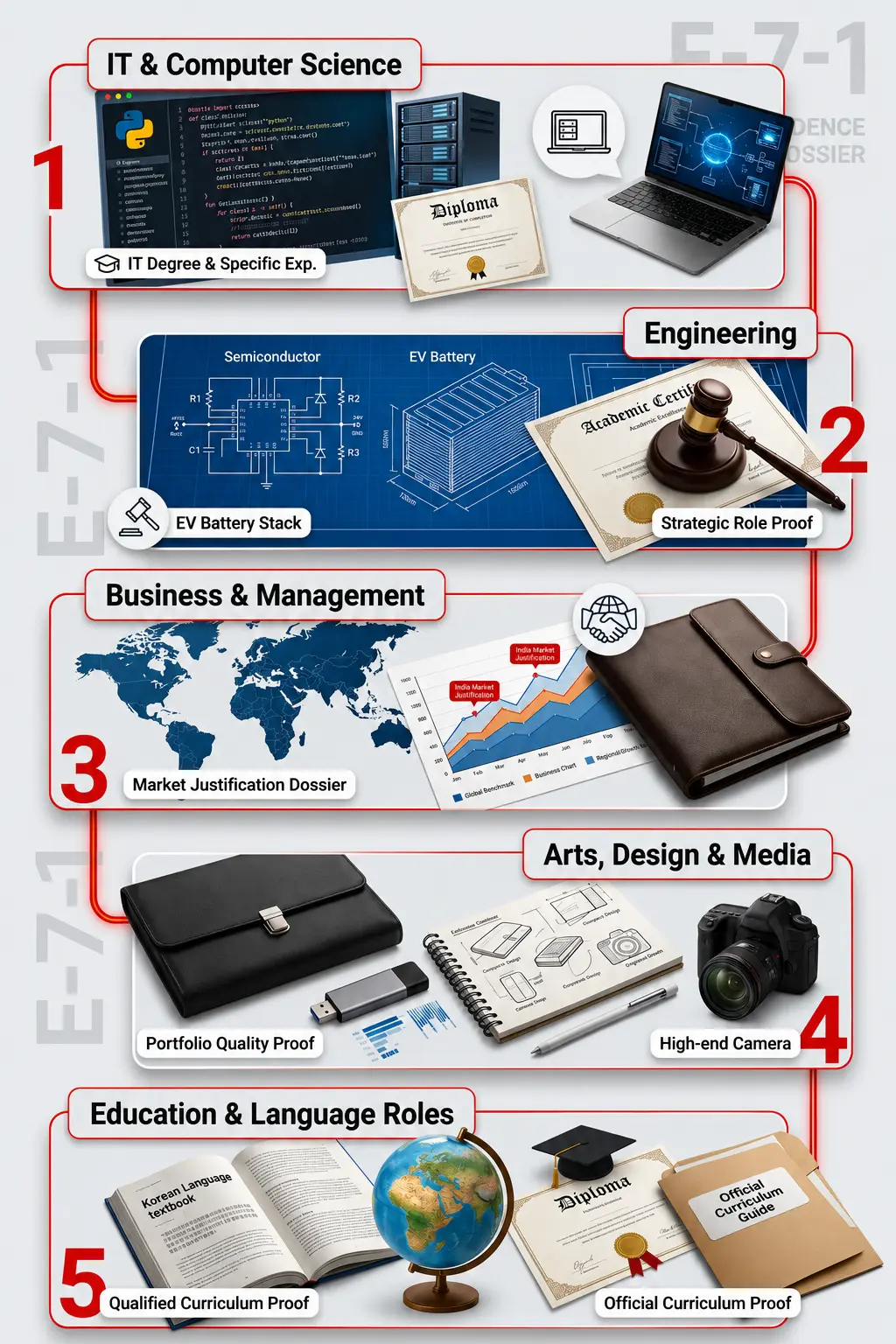
IT & Computer Science: software development, data, and cybersecurity roles often require a directly relevant degree and job-specific experience.
Engineering: semiconductor, EV battery, mechanical, electrical, and shipbuilding roles are strategically important and closely checked.
Business & Management: companies may need to justify why a foreign professional is specifically required for international or India-market roles.
Arts, Design & Media: portfolio quality matters, and freelance or project-based arrangements are generally not allowed under this route.
Education & Language Roles: teaching and curriculum roles can follow different visa patterns and qualification expectations.
| Requirement Area | What It Means | Why It Matters |
|---|---|---|
| Salary Floor | Your base annual salary must meet the minimum amount required for the visa category and company profile. | Below-threshold contracts can lead to direct visa refusal or extension problems later. |
| 5:1 Workforce Ratio | Many sponsoring companies must employ at least five Korean nationals for every one foreign professional. | This supports local labor protection and is often reviewed with official insurance records. |
| Major-to-Job Match | Your degree and experience should clearly align with the selected job code and actual job duties. | Mismatched applications face high scrutiny and a stronger chance of rejection. |
| Necessity Statement | Some business and market-facing roles need a clear explanation of why a foreign expert is essential. | This is especially important in international sales, management, and market expansion roles. |
Manual labor, delivery work, unauthorized side jobs, and business ownership outside the visa scope can cause serious penalties.
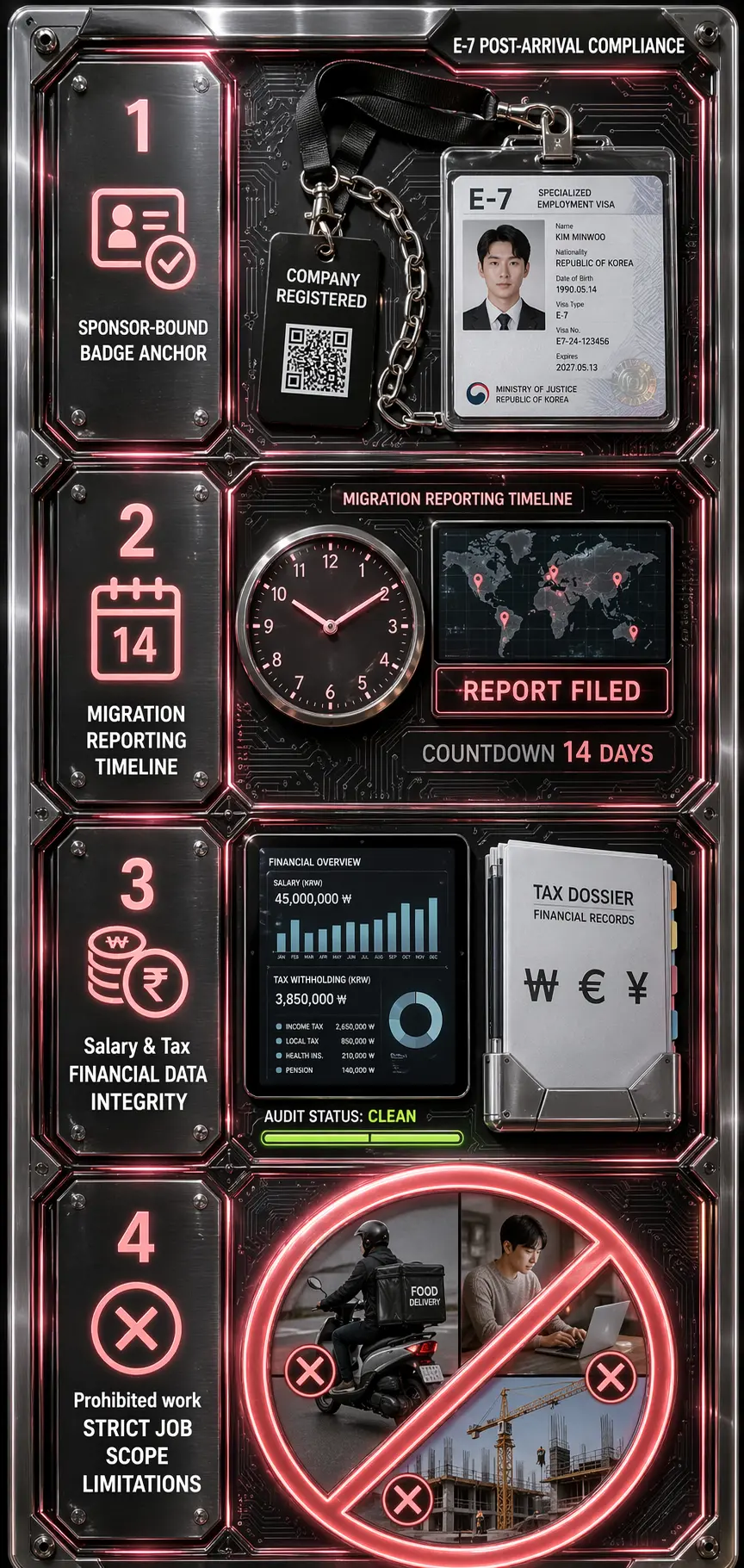
Some of the biggest risks come after approval, especially when changing address, changing jobs, or planning family relocation.
Obtain the required release or consent documentation when leaving early.
Transfer sponsorship before starting work at the new company.
Never begin work during the transition unless the immigration change is officially approved.
Spouse and children may usually join on dependent status if eligible.
A spouse on dependent status generally cannot work without changing to an appropriate work visa.
Your dependents’ legal stay is directly connected to your own visa validity.
The long-term route depends on continuous residence, verified income, social integration, and clean legal compliance.
| Track | Typical Residence | Income Target |
|---|---|---|
| General Track | 5 consecutive years | Higher income benchmark based on national income standards |
| Advanced Degree / STEM Track | 3 consecutive years | Lower benchmark than the general track, but still strictly reviewed |
Choose the right F-5 track based on your degree, residence history, and income.
Complete KIIP integration requirements and the permanent residency test requirement where applicable.
Prepare income certificates, employment proof, residence proof, and a fresh apostilled police clearance.
Maintain stable employment during review and avoid long absences that may interrupt the residency count.
Salary benchmarks and income certificates are reviewed carefully. Aim for a safe buffer rather than the exact minimum.
These common questions help users understand what matters most before applying or moving.
Get expert guidance and build a clear, step-by-step migration plan today.