South Korea offers globally respected universities across technology, engineering, business, arts, language education, and research. These institutions provide strong academic standards, innovation-led learning, and growing opportunities for international students.
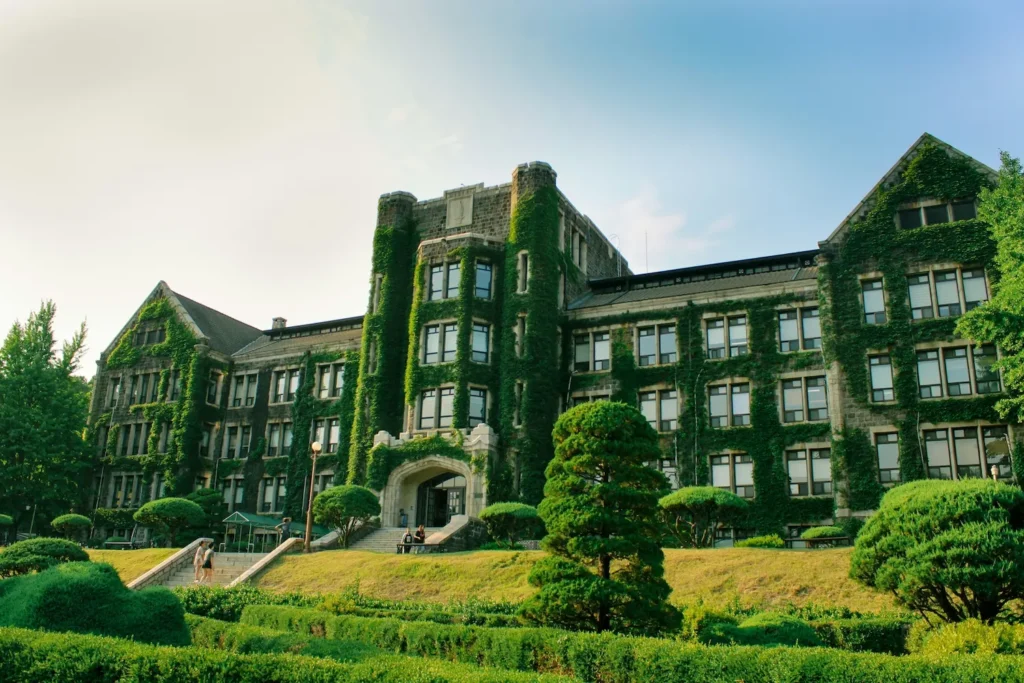
Seoul National University, Yonsei University, Korea University, KAIST, DGIST, UNIST, GIST, and Sungkyunkwan are among the most recognized names.
Kyungpook National University, Kangwon National University, Kumoh National Institute of Technology and other public universities offer quality education with strong affordability.
| University | Type | Focus | Category |
|---|---|---|---|
| Seoul National University | National | General | Highly Competitive |
| Yonsei University | Private | Business / Global | Highly Competitive |
| Korea University | Private | Business / Global | Highly Competitive |
| KAIST | Technology Institute | Engineering | Highly Competitive |
| DGIST | Technology Institute | Engineering | Competitive |
| UNIST | Technology Institute | Engineering | Competitive |
| GIST | Technology Institute | Engineering | Competitive |
| Sungkyunkwan | Private | General | Highly Competitive |
| Kyungpook National University | National | General | Competitive |
| Kyungdong University | Private | General | Accessible |
| Sejong University | Private | Business / Tech | Competitive |
| Ajou University | Private | Engineering | Competitive |
| Yewon Arts University | Arts | Creative | Accessible |
| Hankuk University of Foreign Studies | Private | Languages / Global | Highly Competitive |
| Kumoh National Institute of Technology | Technology Institute | Engineering | Competitive |
| Catholic Kwandong University | Private | General | Accessible |
| Kangwon National University | National | General | Competitive |
| Korean Bible University | Specialized | Religious Studies | Accessible |
| International Graduate School of Language Education | Specialized | Languages | Accessible |
Choosing South Korea for higher education is a strategic decision for Indian students. The country combines academic discipline, modern research, industry collaboration, and practical career pathways in a highly safe and efficient environment.
Study in the birthplace of advanced AI, semiconductors, 6G innovation, and smart city development. Universities often work closely with major companies like Naver and Kakao, making coursework more industry connected.
South Korea leads in automotive, shipbuilding, robotics, electronics, batteries, and smart manufacturing. Students get access to research-funded labs and industry-backed technical ecosystems.
Cost-Efficiency:
Tuition can be 40–60% lower than the US or UK.
Safety:
Korea is considered one of the safest destinations for international students.
Post-Study Work:
Structured job-seeking and professional visa pathways are available.
Cultural Synergy:
Shared values around education and family help many Indian students adapt faster.
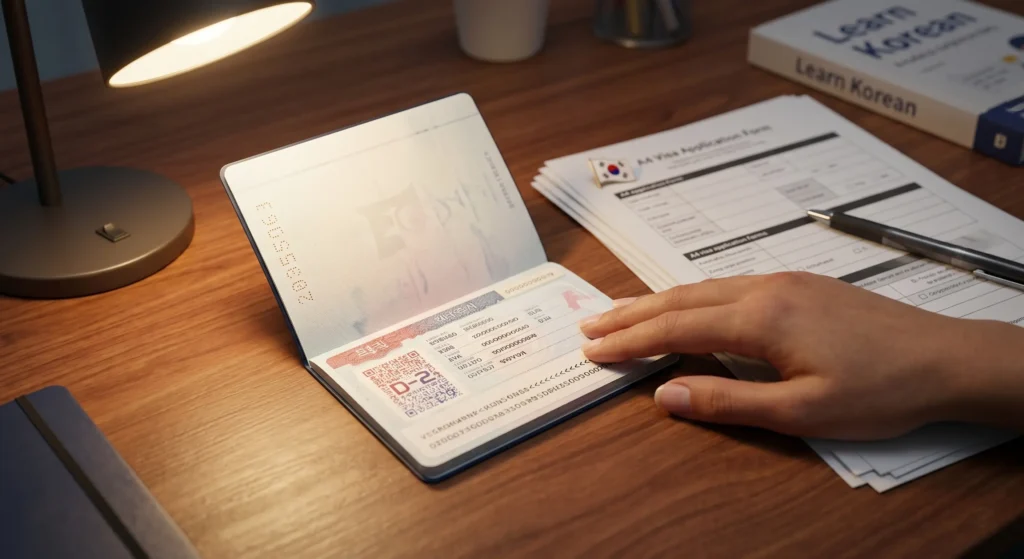
✓ D-2 Visa: Required for degree programs such as Associate, Bachelor’s, Master’s, and PhD.
✓ D-4 Visa: For students joining Korean language institutes affiliated with a university.
✓ Passport with minimum 6 months validity
✓ Visa application form with passport-size photo
✓ Original CoA and university business certificate copy
✓ Apostilled academic qualifications
✓ Financial proof and bank statements
✓ ITR, sponsor affidavit, and relationship proof if sponsored
✓ TB test report from embassy-designated hospital
✓ Study plan and statement of purpose
✓ Receive academic admission letter from the university
✓ Pay tuition and obtain Certificate of Admission (CoA)
✓ Apostille Indian educational documents through MEA
✓ Submit through KVAC centers such as New Delhi or Chennai
✓ Receive Visa Grant Notice after approval
✓ Check whether your university is an Excellent IEQAS certified institution for simplified screening.
✓ Start the Apostille process early because it can take time.
✓ Maintain financial balance properly and avoid sudden large deposits.
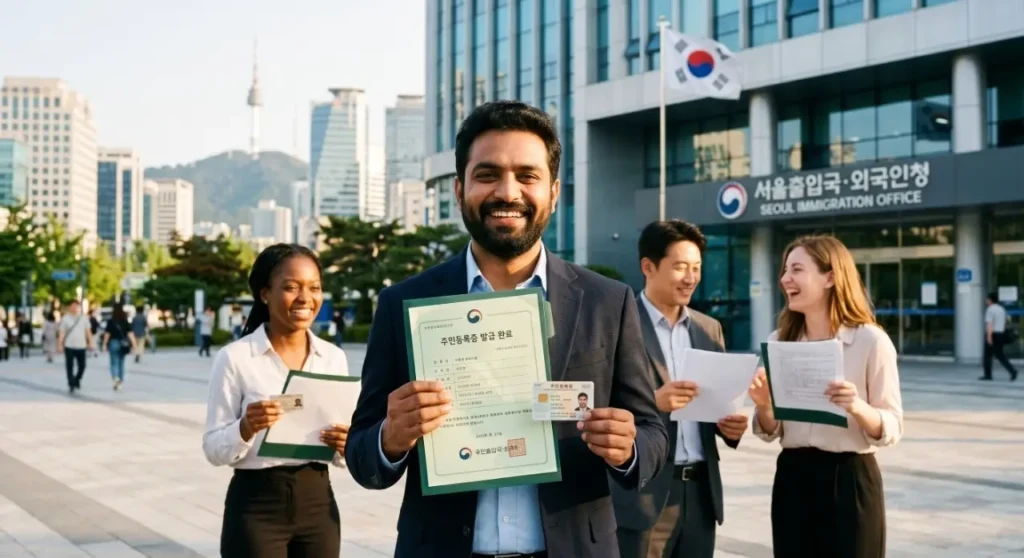
✓ After arrival, apply for your Residence Card within 90 days.
| Fee Type | Approximate Cost | Note |
|---|---|---|
| Embassy Visa Fee | ₹5,100 | May vary by exchange rate |
| KVAC Service Fee | ₹2,500 – ₹3,200 | Per application |
| TB Medical Test | ₹3,500 – ₹6,000 | Depends on hospital |
| Total Preparation Cost | ₹11,100 – ₹14,300 | Excluding Apostille |
Graduates without an immediate job offer can move to D-10-1. It works as a bridge phase and supports active job search after graduation.
✓ Can be renewed in intervals
✓ Requires documented proof of active job search
✓ Useful for interviews, fairs, and internships
For top STEM Master’s and PhD graduates from designated institutions. It offers a direct residency-oriented pathway with greater freedom.
This is the standard full-time professional visa after getting a relevant job offer. The role must align with your academic background.
✓ Salary threshold must meet the required benchmark
✓ Job should match your degree field
✓ Widely used for professional employment
A regional residency route for graduates who are willing to live and work in designated population-declining areas outside Seoul.
✓ Maintain required funds for D-10 extensions
✓ Join KIIP early for long-term immigration benefits
✓ Check salary threshold carefully before signing an E-7 contract
✓ Prefer internships in your final semester for easier conversion to full-time roles
Students on D-2 or D-4 cannot work legally without an approved part-time work permit. The general process is job offer, university approval, then immigration application.
✓ D-4 students usually wait before applying
✓ D-2 students can apply earlier if GPA condition is met
✓ Minimum GPA requirement is important for approval
Working hours depend on degree level and TOPIK proficiency. Higher language proficiency usually allows more working hours.
✓ Undergraduate students can access higher weekly limits with TOPIK
✓ Master’s students typically receive more flexibility
✓ Doctoral students may work the highest allowed hours
✓ Vacations and weekends generally provide much wider flexibility
International students are protected under labor law and receive the same minimum wage protections as Korean citizens.
✓ Minimum wage mentioned in the file: 10,320 KRW/hour
✓ Payment should go to a Korean bank account
✓ Employment contract and legal pay standards matter
✓ Adult entertainment venues
✓ Illegal tutoring without proper visa
✓ Delivery rider services on student visa
✓ Manufacturing or construction unless approved under special internship conditions
Never exceed approved hours or work without permit. Immigration and tax data are increasingly monitored, and mismatches can affect visa renewal.
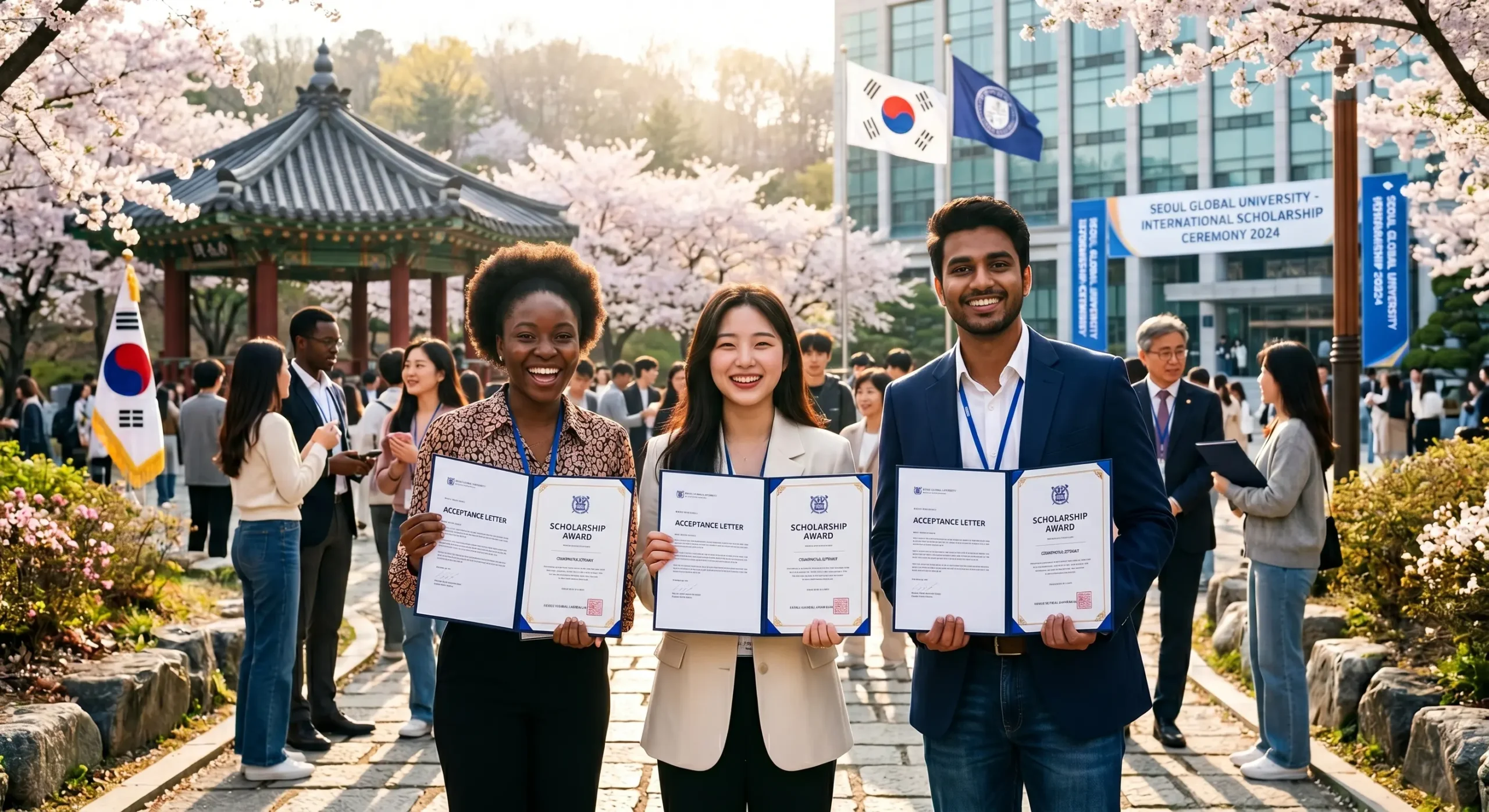
One of the most comprehensive government scholarships for international students.
✓ Full tuition coverage
✓ Monthly allowance
✓ Airfare support
✓ Insurance and settlement support
✓ Korean language training included
A scholarship pathway for arts students, especially those applying to Korea National University of Arts and related fields.
Designed for talented students with financial need and social impact potential.
KAIST, SNU, GIST and many other universities offer tuition waivers, stipends, assistantships, and insurance benefits.
Supports future Asian leaders, especially at top institutions and in selected academic areas such as STEM and policy.
Academic documents from India generally need Apostille legalization through the Ministry of External Affairs. This is an important requirement for many scholarship and final admission processes.
Bachelor’s Degree :
Entry-level competition is stronger, and students are expected to be technically ready. TOPIK can make a major difference in opportunities available.
Master’s Degree :
Considered a strong level for professional employment. Korean companies often value specialized skills and local academic exposure gained during a Master’s.
PhD:
Very strong prospects in R&D, innovation, universities, and major industrial labs. Compensation can include added benefits such as research support and housing-related perks.
Major demand in semiconductors, AI, green energy, batteries, robotics, and advanced manufacturing.
Start networking early, use student communities, focus on internships in the final semester, and ensure your offer meets the visa salary conditions before accepting.
TOPIK is the official Korean language proficiency examination used by universities, employers, and immigration systems to measure language ability.
✓ TOPIK I: Beginner level with reading and listening
✓ TOPIK II: Intermediate to advanced level with writing, reading, and listening
✓ Levels range from 1 to 6
✓ Score validity is generally 2 years
✓ Improves scholarship competitiveness
✓ Can increase part-time work hour eligibility
✓ Supports graduation requirements in some universities
✓ Strengthens job and long-term residency prospects
TOPIK is conducted multiple times a year and major centers can include cities like Delhi, Chennai, Bengaluru, Pune, and others depending on the cycle.
✓ Start early from India if possible
✓ Focus strongly on TOPIK II writing practice
✓ Strengthens job anUse TOPIK as both academic and immigration support
KIIP is a government-designed integration program that teaches language, society, law, and daily living in Korea. It is especially important for long-term settlement planning.
✓ Helps earn points for F-2 and F-5 visa routes
✓ Completion remains valid permanently
✓ Can support work-hour flexibility and long-term immigration planning
✓ Builds practical cultural understanding for life and jobs in Korea
✓ Level 0 basic literacy
✓ Levels 1 to 4 language and daily life
✓ Level 5 focuses on Korean society and residency-oriented learning
✓ Use your TOPIK result to skip lower levels where possible
✓ Choose nearby or hybrid centers if available
✓ Maintain attendance because missed classes affect progression
An elite pathway for high-performing STEM Master’s and PhD graduates from major Korean research universities.
✓ Focus on AI, semiconductors, robotics, biotech, cybersecurity, aerospace and related fields
✓ Merit-based pathway linked to academic excellence
✓ Can support direct transition toward long-term residency status
Built for graduates willing to live and work in designated regional areas outside the Seoul metropolitan zone.
✓ Useful for both STEM and non-STEM graduates across industries
✓ Requires regional commitment and approved job conditions as per policy
✓ Supports family settlement and long-term stability
Ideal for students in advanced science and technology fields who want more freedom and a faster residency route after graduation.
If you are in a top STEM program, K-STAR may be your strongest long-term path. If you are in business, design, or another non-STEM field, F-2-R can be a more practical route.
✓ F-5-10: Linked to advanced degrees and qualifying work experience
✓ F-5-15: For domestic PhD graduates in professional employment
✓ F-5-16: For long-term residents on points-based tracks such as F-2-7
✓ Improves scholarship competitiveness
✓ Can increase part-time work hour eligibility
✓ Supports graduation requirements in some universities
✓ Strengthens job and long-term residency prospects
TOPIK is conducted multiple times a year and major centers can include cities like Delhi, Chennai, Bengaluru, Pune, and others depending on the cycle.
✓ Start early from India if possible
✓ Focus strongly on TOPIK II writing practice
✓ Strengthens job anUse TOPIK as both academic and immigration support
✓ Freedom to work across companies
✓ No need for constant visa renewals
✓ Easier access to financial systems and housing support
✓ Better family stability and work rights for spouse
✓ Must maintain entry and residency conditions
✓ Tax obligations become more serious
✓ Serious legal violations can affect PR status
✓ Processing can take several months
If you complete a Master’s or PhD in Korea, build your route through study, relevant employment, KIIP completion, and a proper long-term visa transition. For many students, F-2 or regional bridge pathways can make the final PR step easier.
Whether you want to study at a globally respected university, work in a future-focused industry, or launch your own startup journey, South Korea offers a unique mix of safety, ambition, modern life, and opportunity.